Wednesday, October 14, 2009

Who Much Does Skiing Cost

SHIP OF POISONS The Navy had known for three years. The Harbour Master had ordered the blockade of fishery waste was under the sea

Andrea Palladino
the manifesto.it
waste was under the sea
The wreck of Cetraro slowly coming back into the darkness of the seabed. The 500 meters of depth that has hidden for seventeen years longer, become inaccessible. The risk of silence is behind the corner. Yet is there. Yet no one has refuted the story of the ships of the poisons. Indeed, as the archives go back to the surface the list of confirmations lengthens, strengthens you.
The first bad news is: the hazardous waste off Cetraro there. Two areas near the area of \u200b\u200bthe discovery of the wreck last September 12 - a somewhat 'to the north, the other farther east, near the coast - are contaminated with heavy metals: arsenic, cobalt, aluminum and chrome. All of these substances may not come from the coast, where there are no industries. All of these substances, then, that someone threw into the sea.
studies is not the government come in this month of waiting. The identification of the residues is 2006 and is listed in an order of the Port of Cetraro, the 03/2007. The document identifies two quadrilaterals, prohibiting trawling in contaminated areas. The Navy, therefore, knew of the existence of toxic waste off Cetraro at least three years. Too bad that when the prosecutor asked Paola help locate the wreckage, the answer was evasive: we do not ship to be sent.
is the consultant of the Mitrokhin?
There is a second report, which went unnoticed by the newspapers reported only in Calabria. On the ship to lose there has been a reliable source, Admiral Bruno Branciforte, just head AIS - military intelligence - called by COPAS, the Parliamentary Committee for control of the secret services. According to the newspaper Calabria hours, the admiral has confirmed the existence of at least 55 ships used - in various ways - for the illegal transport of waste. The question then would be another hearing on in-depth, but for reference in court if they have not heard from again. Yet the questions to be asked to Branciforte there, because since 1995 we are talking about actions more or less veiled secret service in question, without, however, never have a clear answer? And what role did people like Scaramella - the legendary advisor to the Mitrokhin Commission - or as Aldo Anghessa, appeared several times in the investigations of the nineties on the ships? Everything is silent

Silence, meanwhile, also fell on the investigation proceedings. In mid-September, the Prosecutor Paola Giordano Bruno had to move all cards to the District Anti-Mafia Directorate of Catanzaro. The repentant Frank Wells, with his statements to the press, directly accused the 'Ndrangheta three sinkings, including that of the wreck off the coast of Cetraro. Sources is gone, but in addition, to identify possible sponsors to the highest levels in several interviews. It is therefore puzzling that still has not laid before the magistrates, while the security program - which had been suspended in recent years - has not been reactivated. And as often happens in Calabria, the facts are enveloped in a kind of opacity that prevents people from understanding what is happening. Three judges of Catanzaro - Lombardo, Pignatone and Borrelli - have actually called in recent days in Rome at the headquarters of the National Anti-Mafia Directorate. That day, however, the lawyer for Wells, Claudia Conidi, was engaged in another process. "I had warned the judges of the DDA with a fax machine - he explains - but they wanted to do the same interrogation." Frank Wells, then, did not want to continue. "She felt insecure without a trusted lawyer - the lawyer continues Conidi - without even a security program." And the wait statement is skipped. The problem is that - according to counsel for the penitent - the magistrates of Catanzaro would not want to hear it, at least for the moment. "The prosecutor Borrelli - explains the legal - I hear it said that only if there is a necessity of the case." For now, the words heavy Sources will not, therefore, put on a record. Worried, the penitent has put pen to paper and wrote yesterday to the Public Prosecutor of Salerno, which is responsible for the supervision on the work of the magistrates of Calabria, "He wants to be heard - said the lawyer - with all the guarantees, which so far has not had ' .
Once upon a time the enthusiasm
are so far away the days in mid-September, when the enthusiasm of the prosecutor Paolo Giordano Bruno and by the regional environment Silvio Greek announcing the breakthrough in the long and complex history of the ships of the poisons. The poisons - and that's for sure - are there in the sea and the hills near Cetraro Amantea. Waiting for someone to write the names that were printed on labels on drums thrown into the sea in ships to lose.

Saturday, May 30, 2009

Full Boobs Boobs Pitcher

Bonds weak dative bond

The link is a special form of dative covalent bond. Called dative because a substance is called the employer and other acceptor. It is formed when an element contains one or more doublets available and is typical of non-metals. The most common case is when a species that has an electronic doublet is not shared, such as ammonia, binds a proton H + thus giving rise to the ammonium ion.

Best Place To Get A Wax


The molecular dipoles can give rise to intermolecular forces of attraction.
intermolecular bonds are dominated by the mutual attraction between dipoles static - it is the case of polar molecules - or between dipoles and ions - is the case, for example, a salt that dissolves in water.
In the case of noble gases or compounds formed by nonpolar molecules can liquefy is explained by the random formation of a temporary dipole when the electrons in their orbits, they are randomly concentrated on one side of the molecule, the dipole induced in the molecules near him is an imbalance of electric charge (the so-called induced dipole) that generates mutual attraction and causes condensation of the gas. The link is then produced by these particular forces of attraction called dispersion forces or Van der Waals forces.
A special case of intermolecular bonding, which can also be when the intramolecular geometry of the molecule allows it, is the hydrogen bond. An atom
hydrogen bound to an oxygen atom (or fluorine), because of its positive polarization and its compact size, relatively high intensity attracts the atoms of oxygen (and fluorine and to a lesser extent, nitrogen) close .
That link, although weak, is responsible for the spatial conformation of proteins and nucleic acids, conformation to which the biological activity of the compounds themselves.

What's The Best Overall Baja Mini Bike


The ionic bond is a bond between ions of opposite sign. These ions are formed by atoms having electronegativity difference greater than the conventional 1.9: In these conditions, when two atoms approach (a metal and an atom of an element of the last groups), the electrons in the outermost level of the atom less electronegative spend more electronegative atom. This then becomes a negative ion, while the other atom becomes an ion positivo.Questo binding is purely electrostatic, the arrangement of atoms in space is not the directionality of the covalent bond: the electric field generated by each ion is spreads symmetrically in the space around it.

White Boobs Black Nipple

Ionic bond coordination and covalent bonds delocalized

bond coordination (or dative)
is a special kind of covalent bond that in the past dative because the two electrons involved in the bond come from one of the two atoms that employer (or agent nucleophile), while the other is called acceptor (electrophile or agent) and have an empty orbital in which to "accommodate" this pair.

bonds and delocalized metallic bond
Some covalent bonds, those relocated, they can tie together three or more atoms simultaneously.
The most extreme form of relocation of the covalent bond occurs in the metallic bond. According to this model a metal can be represented as a lattice of positive ions held together by an electron cloud shared across the whole network, since these electrons are not linked to any particular atom, are be highly mobile, this mobility is responsible for high electrical conductivity of metals.

Satellite Phased Array


pure covalent bond A covalent bond is called "pure" when it is formed between atoms with the same value of electronegativity, or between 0 and 0.3. In this case, the electrons are held in common between the two atoms are drawn with the same force on both nuclei and, therefore, are to be shared equally between the two atoms (there is a symmetrical distribution of electron cloud ). The covalent bonds that form between two atoms share two pairs of electrons are called double bond.

Legame covalente polare
Un legame covalente polare si forma tra atomi che hanno elettronegatività diversa, ma non tanto diversa da rendere possibile la formazione di un legame ionico (la differenza dei valori di elettronegatività è sempre minore di 1,7).
In questo caso, i due atomi mettono in comune i loro elettroni spaiati, tramite la sovrapposizione degli orbitali in cui si trovano questi elettroni i quali saranno maggiormente attratti dall’atomo più elettronegativo. Il legame risulterà quindi polarizzato elettricamente, cioè ognuno degli atomi coinvolti nel legame presenterà una carica elettrica parziale, o negativa o positiva.

Funeral Jobs In Japan


Si ha un legame chimico when an electrostatic force holds together more atoms in a molecule or a crystal (strong bonds or intramolecular) or more molecules in a substance in condensed (weak bonds, or intermolecular). The atoms form chemical bonds to achieve a more stable electronic configuration, general electronic configuration of the nearest noble gas, then the octet. The noble gases, which have already reached the octet, do not form chemical bonds.
ties can be strong (pure covalent, polar covalent, ionic, relocation and coordination) or weak (secondary chemical bonds).

Difference Between Graduated And Inverted Bob

Energy Chemical bonds Chemical bonds

To remove an electron in an atom, and then it becomes an ion's can provide a certain amount of energy is called ionization energy which is the minimum energy required to remove it from \\ to an electron and bring it to an infinite distance and which is measured in kilojoules per mole (kJ / mol) in kilocalories per mole (kcal / mol) or electron volts (eV). It depends on the atomic species. Naturally, the more the electrons are close to the nucleus (as in non-metals), the greater the amount of energy that must be given to remove the electrons from the atom. If
leaves the first outer electron from the atom, energy is called the first ionization energy. This posts a p electron, the second one detaches from the s sublayer full s. The third ionization energy of the electron is greater because, while the atom loses electrons, its nuclear charge is constant and the remaining electrons are held more firmly.
The fourth ionization energy is about four times the third.

How Can You Gift Property To A Family Member


The chemical bond is a force of electrical attraction that holds together atoms in molecules and crystals.
There are different types of bond but in any case, the forces holding the atoms are always due to electrical attraction between oppositely charged particles. When two atoms bond, the resulting molecule is a system to lower energy and therefore more stable than the two isolated atoms, this is why there are very few in natuira isolated atoms. There is a difference of energy that exists between the isolated atoms and those legatui and represents both the energy released in bond formation is the energy that we must provide to break free and regain the atoms. The binding energy is energy that must provide a bond to break and this amount is equal to that which is released when that bond is formed.

Friday, May 29, 2009

Laptop Wholesalers In Uae

ionization ionization, the danger of ionizing radiation and the ionic bond

ionization
The phenomenon of ionization is the separation of one or more electrons from atoms or molecules to which they belong, who are charged accordingly positively. Ionization does not result in generation of net electrical charge, but a provision of electric charges for subsequent recombination and reactions within the irradiated field. In physics, fully ionized atomic nuclei, such as alpha particles, charged particles are commonly known. Ionization is usually performed by applying high energy to the atoms in the form of electric potential or radiation. An ionized gas is called plasma. The negatively charged ions are known as anions (which are attracted to the anode) and the positively charged are called cations (and are attracted to the cathode). Ions can be monovalent (indicated by a + or -), divalent (with two + or -) and trivalent (three +). Then ions are divided into monoatomic and polyatomic. For single atoms in a vacuum, there is a physical constant associated with the ionization process. The energy required to remove electrons from an atom is called ionization energy or ionization potential.

The danger of ionizing radiation
Ionizing radiation produces damage: a consequence of the ionization produced by radiation are generated within the new cells, molecules or fragments of molecules very aggressive from the biochemical point of view, capable of irreparably damage at the molecular structures responsible for cell function, or integrity the genetic heritage. The damage can be immediate if radiation dose is likely to directly inhibit the functions of the cell body or bodies to which they belong, or delayed in time in case of damage to the genes of the cell. The amount of radiation energy needed to produce damage, even very serious, is, in absolute terms, very small: nothing compared to the energies involved in the most common tasks of daily life, such as heating a saucepan of water , ol 'pile driving a nail to the wall. For example, the energy of a beam of ionizing radiation can induce, if consumption of the whole body, the death of the irradiated within thirty days with a probability of 50% (an effect therefore of the utmost gravity) would, if fully converted into heat energy, raising the temperature of the body of a thousandth of a degree centigrade, quite negligible. In comparison, the threshold for the onset of physiological effects due to heating by non-ionizing radiation (radio waves, microwaves, ...) is 1 ° C rise in body temperature or by irradiation of the party concerned. Therefore, the risk of ionizing radiation is not due to their high energy content in absolute terms, but the extreme effectiveness of their destructive action against the molecular structure of organized living matter.

The
The ionic bond ionic bond is a type of bond that can take place only between different atoms.
We know that many atoms can be ions, for purchase or loss of electrons: some
, which have low ionization energy, they can easily give cations losing a certain number of electrons, thereby taking an equal number of positive charges. Other
, with high electron affinity, can make a number of anions by accepting electrons, thereby taking an equal number of negative charges. Anions and cations are attracted by electrostatic interaction: this interaction is called ionic bonding. All atoms of 1, 2 and 3 group create ionic bonds with the exception of hydrogen (H) that will create the covalent bond (a bond formed by a pair of electrons shared between two atoms), then the elements of the 5th, 6th and 7th group will buy 3 respectively, 2.1 electrons, these atoms gain electrons because they are very electronegative and tend to attract to that if the electrons, while the 1st, 2nd and 3rd group to become stable electron must give respectively 1,2,3.
ionic compounds are characterized by high melting points and ability to conduct electricity in molten state and in aqueous solution, tend to be soluble in water and crystallize.

Saturday, May 23, 2009

Work In Ottawa Live In Gatineau Tax


The first ionization energy of an element is the energy that must be used to remove the outermost electron from an atom in a gaseous state. The energy of the second, third and so on .... ionization energy is used to remove the second, third, etc. .... electron.
The ionization energy is measured in kJ / mol.

is meant to indicate that the energy required to tear an electron to an Avogadro number, 6.022 x 10 23 atoms of that element.


The ionization energy is greater than the electron is more strongly linked to the nucleus and this is natural because to win a high force is necessary to use more energy.

Remember that electrons, negatively charged particles are attracted to the nucleus where it is concentrated all the positive charge and are more attracted to the higher is the number of protons, that is, the greater the positive charge of the nucleus and the more they are close to the nucleus.

So if we imagine an atom to pull all its electrons starting from the outer gradually until the last that remains, it is easy to imagine that the ionization energies increase as you get closer to the nucleus because the electrons will be retained this with ever greater force.

The second ionisation energy is greater than first-ionization.
The second ionization energy is the energy required to tear an electron to an atom, or rather an ion, which had been previously torn.

Thursday, May 21, 2009

Juliet Cariaga, Watchful Eye

Alkali

series of six chemical elements of group IA (1 in the IUPAC nomenclature) of the periodic table. Are tender when compared to other metals and melt at relatively low temperatures. From the chemical point of view, the alkali metals are strong reducing agents: In order to achieve a stable electronic configuration, for they give in easily the single outer electron belonging to the orbit; react violently with water to form metal hydroxides and releasing hydrogen , which caught fire in the air high reaction temperature. Their high reactivity makes them difficult to find pure nature.

In order of increasing atomic number, they are: lithium, sodium, potassium, rubidium, cesium and francium. This element exists only in radioactive form.

Lithium is the founder of the family of alkali metals. It 's the first solid element, since it follows the hydrogen and helium. It 's a very light metal, because its density is about half that of water. And 'the element with the standard reduction potential more negative. These characteristics are, not surprisingly, the key component of the latest battery technology for electronic devices. In the picture you see it float on the solvent in which it is stored.

Sodium is an element to all known and heard, mainly on mineral water. It too is an alkaline and not many know that apart when dissolved in water, is a soft, silvery, easily cut with a knife. Because of its high reactivity is preserved in oil or Vaseline petroleum ether.

Potassium, also tender and brightly colored metal, is characterized by sodium and lithium ahead of him for even greater responsiveness.

rubidium, retain the same properties as its cousins \u200b\u200balkaline but is distinguished by a very high price, of nearly € 150 per gram!

cesium, which is also very expensive, although not as rubidium, has literally marked our time: In 1967 the Thirteenth General Conference on Weights and Measures defined the second as the duration of 9,192,631,770 periods of radiation corresponding the transition between two hyperfine levels of the ground state of the cesuio 133.

Swollen Glandsalcohol

elements of internal transition - Lanthanides and actinides


ELEMENTS OF INTERNAL TRANSITION -
lanthanide elements and actinide elements of the block f are commonly called inner transition elements or rare earths
what you thought were not very common in nature. They consist
Two series of 14 elements and are arranged in the 6th and 7th period between the 3rd and 4th
group of the periodic table. Usually they are represented separately from other items
simply for a more meaningful representation of the periodic table itself.
The two series are also indicated by the name of the element that precedes each of them. So we will have the series of lanthanide or lanthanides (6th season) and actinides or attinoidi (7 th period). The Lanthanides


character elements are metallic, silvery-white, highly electropositive and reactive
. The atomic radii are very similar (between 1.02 and 0.86 Ã…). Their chemistry is so similar as to have led, until 1907, to consider a single element.
The lanthanides are all in nature, with the exception of promethium (Pm, Z = 61 and obtained synthetic), which are only found in compounds. Although it is commonly known as rare earths and nature have a certain abundance. For example, the Ce (6.6 ° 10.3% by weight in the crust; 25 th most abundant element) has an abundance similar to that of Cu and is about four times more abundant than Pb.
Actinide

character elements are metallic, silvery-white, responsive.
are all radioactive, with short relatively short half-life (except for 232Th, 235U and 238U have t ½ comparable age of the earth and are called primary source).
The only elements of the actinide series to exist in nature, even if not widespread, are Th, Pa and U.
All others have been produced synthetically by nuclear reactions.

Can A Pressa Beat A Tosa ?

metals, non - metals and metalloids ..... The chemistry of carbon

elements belonging to groups 3, 4 and 5 A include both metals and non - metals.
The metallic character of the elements increases as you go down the table and the last member of each group shows metallic properties.
The classification of elements as metals or non - metal case based on their electronic structure and are
- M Etalle : Elements with a number of outer electrons low, less than or equal to that of the external orbital sep, and with low ionization energy. Therefore, the transition elements, the lanthanides and attinoidi have 1 or 2 electrons if the metallic character increases going down each group;
- N on-metal : elements with numbers greater than the number of electrons outside the outer orbitals sepe with high ionization energy.
- In addition there are the metalloids : elements that can behave like metals or non-metals in particular situations, are those of the border between the two types.

Itunes Error System Not Modified


The elements contained in Group 5 of the periodic table (prepared according to IUPAC ) are:
vanadium (23)
niobium (41)
tantalum (73)
dubnium (105)
These elements are classed in Group 5 because their 5
electrons in the valence shell. Dubnium not exist in nature.


Vanadium Vanadium is the '
chemical element of atomic number 23. Its symbol is V. It is a rare element, soft and ductile, which is in the form of a compound in certain minerals. It is mainly used in metallurgy for the production of alloys.
Features: V is present in abundance of 0.0136% (136ppm) that is the 5th most abundant element among the later transition elements Fe, Ti, Mn and Zr
Vanadium is a bright white metal, soft and ductile. It has good resistance to corrosion
by alkali , 's sulfuric acid and ' s hydrochloric acid. Exposed to ' air you oxidizes rapidly at temperatures above 933 K (660 ° C).
Vanadium has a good consistency and a small cross section
with neutrons from nuclear fission , making it suitable for use in applications related to nuclear energy production . Chemically
shows an intermediate response between
metal and non-metal both acid that basic . The
oxidation states most frequently assumed by the vanadium compounds are +2, +3, +4 and +5. In a laboratory experiment can be observed colorimetrically by the passage of these vanadium oxidation states during the reduction of ammonium vanadate with NH4VO3 zinc metal.
In rare cases, the vanadium oxidation may also take the number of +1.


Niobium Niobium, also formerly known by the name of Columbia because the discovered together
tantalum in the mineral columbite , is the ' chemical element of atomic number 41. Its symbol is Nb. It is a transition metal rare, soft, ductile, gray. Is extracted from niobate and is mainly used in the production of special alloys and high strength welds.
Features: Niobium is a shiny gray ductile metal that takes on a bluish tinge when left exposed to air at room temperature for prolonged periods. The chemical properties of niobium are similar to those of
tantalum, which belongs to the same group of the periodic table of the elements, this similarity in the reactivity of Nb and Ta is due to the fact that their dimensions are almost identical, strange thing can be explained by the lanthanide contraction .
Even at high temperatures, is processed in an inert atmosphere, since already at 200 ° C tends to undergo oxidation
. His
oxidation states most common are +2, +3 and +5.


Tantalum Tantalum is the '
chemical element of atomic number 73. Its symbol is Ta.
is a transition metal
hard and malleable, shiny, blue-gray, very resistant to corrosion, especially the attack of acids , and is a good conductor of heat and electricity. It is rather rare in nature and is found in mineral tantalite . Tantalum is used in surgical instruments and installations intracorporeal implants, because they do not react with body fluids.
Features: As already stated, tantalum is highly resistant to corrosion, in practice, at temperatures below 150 ° C
, it can be considered completely immune to chemical attack, even at extremely aggressive substances as the ' aqua regia, and can be affected only by' hydrofluoric acid, from acid solutions containing fluoride ion and sulfur trioxide free. Tantalum has a very high melting point, surpassed only by tungsten and rhenium (3290 K melting point, boiling point 5731 K). Tantalum has the highest electrical capacity specific than any other substance.

Dubnium
Dubnium 's
chemical element in the periodic table of elements, that has the symbol Db and atomic number as 105.
is a synthetic element, highly radioactive isotope which
has a more stable half-life of less than 40 seconds. This element therefore has no practical applications and its properties are poorly understood.

Barcelone Drinking Laws


Carbon is a special element, can form carbon composti.Il million in the second period and belongs to group 4. Has Z = 6, denoted by the symbol C, atomic weight 12.01115. The most abundant naturally occurring isotope is 12C, 13C are also eil 14C.La electronic configuration of carbon is 4, tells us that epiùesterni, disponibili.Il C can then form 4 single bonds.

Pregnancy With Glioblastoma

Link fifth group on the periodic table

http://corsiadistanza.polito.it/corsi/pdf/9065N/modulo/chimica5.pdf

Wednesday, May 20, 2009

Black Female Horse Genital

THE ATOMIC ORBIATLI

Please display an atomic orbital, it is approximated with that part space around the atomic nucleus where the probability of finding an electron is maximum. This means that a region of space around an atomic nucleus is used to graph an orbital orbital can atomico.Questo be represented by a cloud with a density of color is directly covered proportional to the probability of finding an electron at that point. To calculate the probability that an electron is in a given space is multiplied by the square of the wave function for the volume dr.
The number and the extension of atomic orbitals can be obtained from the solution of the Schrodinger equation.
For the Pauli principle, each electron can cntenere than electrons. Rempe starting orbitals are those with minimum energy and gradually filling those supeiore of energy.
If there are any orbital degenerate orbitals are distributed preferezialmente to fill as many

Jacopinho antolini with the collaboration of Francesco Fois

Saturday, May 16, 2009

Repair Trace Motherboard

First group - Alkali metals Group


The first group of the periodic table is divided into two groups: Group 1 A

includes elements with a single monovalent outer electron nell'orbitale type s.

Except for hydrogen (with special characteristics), the elements that compose it are alkali metals.

latter react violently with water, and develops considerable heat:
- Hydrogen (H Symbol, Z = 1) is the lightest and most abundant element in the universe, incolore, inodore ed è altamente infiammabile;
- Il litio (Simbolo Li, Z=3) è un metallo soffice di colore argenteo, altamente ossidabile;
- Il sodio (Simbolo Na, Z=11) è, come il litio, un metallo soffice e argenteo, ma è molto reattivo e brucia facilmente;
- Il potassio (Simbolo K, Z=19) è un metallo soffice bianco-argenteo, dalle caratteristiche chimiche simili al sodio;
- Il rubidio (Simbolo Rb, Z=37) , di colore bianco-argenteo, è debolmente radioattivo e spontaneamente infiammabile all’aria;
- Il cesio (Simbolo Cs, Z=55) è un metallo alcalino di colore argenteo-dorato, tenero e duttile, ed è uno dei tre metalli che si possono found in the liquid state at room temperature;
- Francium (Fr Symbol, Z = 87) is the heaviest of the alkali metals and unstable, and is the natural state in uranium and thorium.
Group 1 B includes in copper, silver and gold, which can have value greater than 1.
are called "transition metals" because they must be regarded as terms of the following passage from Group 8 Group 1:
- The copper (symbol Cu, Z = 29), reddish in color, has a high electrical and thermal conductivity, ductile, malleable, and is also highly resistant to corrosion;
- The silver (symbol Ag, Z = 47), white and gloss is the best conductor of heat and electricity between metals, occurs naturally in mineral form and pure;
- gold (symbol Au, Z = 79) is a transition metal soft, heavy, ductile, malleable and yellow. And 'only attack directed water and mercury, and is a state of nature in the form of flakes or nuggets.

Indian Sharking Hidden Cam


According to the orbital elements of the model should be a group are characterized by an electronic configuration with five electrons in the valence shell, which is why in previous conventions this group was called before VA, then 5A.
Nitrogen and phosphorus are not metals, arsenic, with very similar properties to phosphorus, is a metalloid, antimony and bismuth metals. The most common oxidation numbers for this group are ± 3, ± 5; exception is nitrogen, which also offers ± 1, ± 2, ± 4.

Nitrogen is a chemical element with atomic number 7. Its symbol is N (from the Latin Nitrogenum). Nitrogen is the main component of the organic molecules important in terms of biochemical (DNA, proteins, vitamins), as well as extremely popular and important inorganic compounds such as ammonia and nitric acid. The molecular nitrogen (N2, consisting of two nitrogen atoms) is a colorless, odorless, tasteless and inert, which accounts for 78% of Earth's atmosphere (this is the most common gas in the air). Nitrogen is the fifth most abundant element in the universe, the 19th Earth's crust, which is 0.03% and the fourth in the human body, which is 3%.
Phosphorus is a chemical element with atomic number 15 and symbol P.È a non-metal group nitrogen. Phosphorus is not found in nature at its most elementary, but in the form of phosphate (salt of phosphoric acid), is abundant in rocks and in living cells, whose metabolism is an essential component. The main industrial use of phosphorus in fertilizer production. It is also used in the production of explosives, matches, fireworks, pesticides, toothpaste and detergents. Phosphorus appears as a white waxy solid with a characteristic unpleasant garlic odor, and when is very pure and transparent. It is insoluble in water and soluble in organic solvents, such as carbon disulfide. Upon contact with air burns spontaneously forming phosphorus pentoxide, P2O5.
Arsenic is a chemical element with atomic number 33. Its symbol is eg rotary is a semi-metal that comes in three different allotropic forms: yellow, black and gray. Pure arsenic is not poisonous, but they are all compounds that are used as pesticides, herbicides and insecticides.
antimony and a chemical element with atomic number 51. Has the symbol Sb, from the Latin meaning stibium stick. It is a semi-metal that comes in four different allotropes. The stable form has a metallic bluish-white, unstable forms have yellow or black. It is used as an agent and flame retardant to produce paints, enamels, ceramics and rubber, and a wide range of metal alloys. As a semi-metal, antimony has the look of a metal, but does not have the typical physical and chemical behavior. In its elemental form is a white solid bluish-silver hues that have low electrical and thermal conductivity and that sublimates at relatively low temperatures. Reacts with oxidizing acids and halogens. Antimony and its alloys expand on cooling.
Bismuth is a chemical element with atomic number 83. Its symbol is Bi. It is a heavy metal and fragile-looking white-rose whose chemical behavior is similar to that of arsenic and antimony. It is the most diamagnetic of metals and, with the exception of mercury, the one with the lowest thermal conductivity. It is a brittle metal with a white color with pink and iridescent. It is the heaviest of the so-called "heavy metals" and is the only one of them not to be toxic. It is the metal that has the highest resistivity.
On heating in air may ignite and burn with blue flame, producing fumes yellow oxide of bismuth.

Friday, May 15, 2009

Hydrochlorothiazide With Addera

Fifth Group two - alkaline earth metals Group


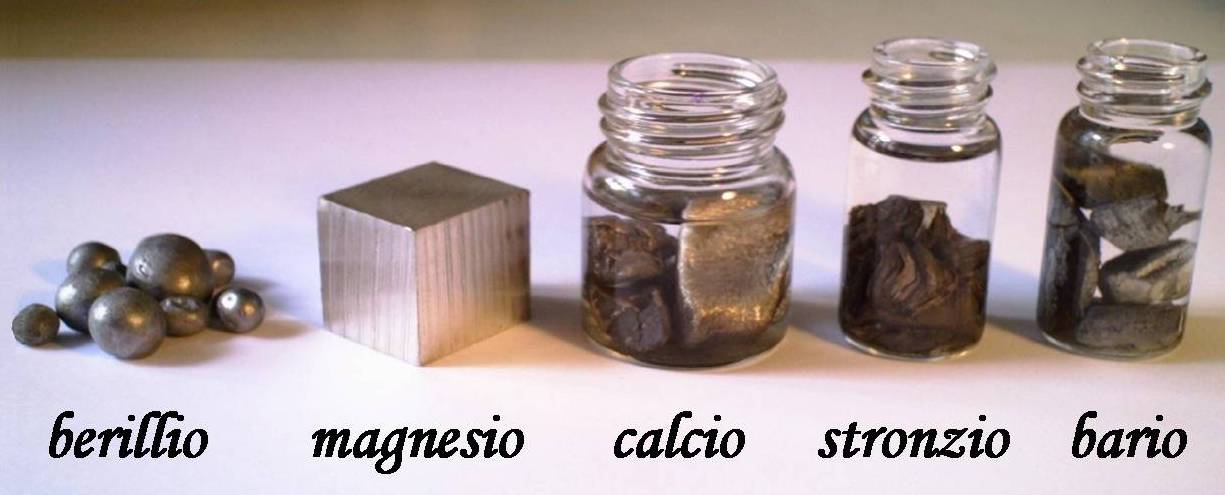
the second group, called the alkaline earth metals, are part of Beryllium, magnesium, calcium, strontium and barium. These elements have two valence electrons in divalent as hydrides are obtained as BeH2, MgH2, and oxides such as MgO, CaO, ... They are all soft metals, malleable, very light and good conductors of heat,
with very different properties and reactivity . Beryllium is very hard, has a relatively high melting point, and gives rise to highly toxic compounds. Even the metal, reduced to dust, it is toxic. It 'also the least reactive of the group. Magnesium is known to all, and is the industrial metal lighter. Football, as everyone knows, is a component of bones and is present in the plaster, as well as a myriad of other compounds. Elementary state is very reactive, as it is preserved under liquid paraffin. Strontium and barium are heavier than the previous ones, are also more responsive and less known. They react readily with water creating hydrogen.

Other material on the reactivity elements of the second group: http://www.tavolaperiodica.it/reattivita_metalli_alcalino_terrosi.html

Free Driver For Manhattan Webcam 300


The elements of group VI are: oxygen, sulfur, selenium, tellurium and polonium. The oxygen and sulfur are nonmetals, the metalloids selenium and tellurium are semiconductors, while polonium is a metal. The main features are:
  • all are solid at room temperature, except the oxygen and gaseous
  • their atoms have six outer electrons, two on a type s orbital, and four out of orbit type p;
  • have all the oxidation state of -2 when they bind to the less electronegative. When they bind to electronegative elements are the oxidation states +4 and +6, with the exception of oxygen, this being the second element after elttronegatività fluoride, has a positive oxidation state only when bound to fluorine (and in this case states can take +1 or +2);
  • have two pairs of paired electrons, and thus can form two dative bonds with the role of donors; exception of oxygen, which, given its high electronegativity, it does not behave donor, acceptor, but, as an acceptor and can form a single dative bond;
  • hydrogen forming compounds which are present in an atom and two hydrogen atoms of the element.

The elements of Group VI A, the group also Ext 16, are called chalcogens, the name has generally been derived from the Greek words chalcos "mineral" and-gen "formation", then the generator of minerals. The compounds, including sulfides, tellurides and the selenuri are also known as chalcogenides.

Oxygen was discovered in 1774 by Joseph Priestley, was known from ancient sulfur, selenium was discovered in 1818 by Jons Jacob Berzelius, tellurium in 1783 by von Mueller Reichestein, and polonium in 1898 by Pierre and Marie Curie.

Thursday, May 14, 2009

Woman's Out Of Control Hen Night

Sixth Seventh group

Group 7 of the periodic table consists of elements :
manganese (25)
technetium (43)
rhenium (75)
Bohrium (107)
these elements are classed in Group 7 because they all have 7 electrons in the valence shell.
Manganese is a metal, is the ' chemical element in the periodic table that has the symbol Mn and atomic number 25. Technetium
's chemical element of atomic number 43. Its symbol is Tc.

Rhenium 's chemical element of atomic number 75. Its symbol is The King

Bohr 's chemical element in the periodic table of elements, that has the symbol Bh and atomic number as the 107.

At room temperature, these elements are all solid, the color red for the atomic numbers indicates that the element is synthetic and not found in nature.

Halogens.

The halogens are a group of highly reactive elements, these tend to acquire an electron to achieve a stable electronic configuration. Fluoride is a colorless, highly reactive gas that is able to attack even the glass. Chlorine is a gas instead of the characteristic yellow-green pools. Bromine is a red volatile liquid scent irritant. Iodine is a dark purple solid that sublimates easily, leaving brown spots in the point where it is placed. These elements are strong oxidants are corrosive and in some cases respond to simple contact with a reducing agent.

How Much For Half Head Of Highlights

Periodic properties of elements in the periodic table

the early nineteenth century, scientists began to tidy up the increasing amount of information they had available. In 1869, these efforts culminated in the 'development of what today is called the periodic law, which states that certain physical and chemical properties to express themselves at regular intervals when the elements are arranged in order of increasing atomic number.
Frequency In chemistry, Law which states that the chemical and physical properties of the elements recur in a systematic way for atomic numbers increasing. In the periodic table the elements are distributed according to the external electronic configuration. In particular, see the table in vertical position (for groups), we find elements that have the same number of electrons nell'orbitale outside, and for this reason they have similar physical and chemical characteristics. Instead of moving in a horizontal direction, ie by reading the table for periods, we find that electrons in atoms present nell'orbitale outer rise, continuously, from 1 to 8. When a period is completed, it will start a new one, so that the configurations external electronic, and with it the chemical properties of elements change periodically repeating line by line (ie, period by period). Adjacent elements within a period, therefore, have an electronic structure that varies regularly through it and therefore are characterized by a parallel change of ownership. The most important periodic properties: atomic radius, ionization, electron affinity and electronegativity. More precisely, the atomic radius increases moving in the periodic table from top to bottom, ie in individual groups and decreases from left to right, ie in each period. The first ionization energy, the affinity Electronic el'elettronegatività increase from left to right in the periodic table, but decrease from top to bottom.

Free Communication Boards For Cva Patients

CHEMISTRY? Eighth

The tests covered by REACH (Registration, Evaluation, Athorisation of Chemicals) consist, for the majority of cases, chemical testing on animals. In 2005 it was estimated that it would have been killed up to 50 million. It
experiments on rats, rabbits and dogs to determine whether a substance
- is toxic to humans
- is harmful to human eyes
- is irritating to human skin
- causes cancer or birth defects in humans
- interferes with the human endocrine system (glands, liver, pancreas, etc.)

But significant differences in anatomical, physiological, biochemical and metabolic between organisms of the species on which human experiences and the body, are such as to make reliable and truthful human application of the results animals.
Here are some of the most glaring example.

IRRITATION
How : an animal commonly used, and provided for in the REACH for eye irritation is the albino rabbit. In most cases it is not expected anesthesia. With this experiment we try to identify the irritation caused by a substance that comes in contact with eyes. Is introduced in one eye (the other serves as a control) a predefined quantity of the substance to be tested, and we study the possible reactions: flushing, redness, swollen eyelids, ulceration, lacrimation.

Critique: The ocular responses to a chemical substance is closely related to the anatomy of the eye and the immune status, physiological and genetic animal. And also: •
the human eye is structured very differently than in the albino rabbit. •
our cornea is thicker and covers a lower percentage of ocular surface. •
an ocular membrane (M Bowman's) man is six times thicker. •
our tears is able to expel harmful substances while the rabbit is very low and the substance remains in the eye for longer
• eyelids, which play an important role in the removal of substances, are very different .
The degree of irritation is also evaluated in a totally subjective operator running the test, so the response will depend on its experience and sensitivity and not by objective evidence.

Alternatives: You can alternatively take an integrated study based on mathematical methods, statistical and chemical, for example by simply measuring the pH of the substance. Or make use of other biochemical tests such as measurement of proteins released by the tear fluid after exposure to the substance.

TOXICITY 'REPEATED
How : the repeated dose toxicity testing required by REACH involves the use of 60 rats for each substance and possibly 32 dogs. The experiment aims to identify the toxic effects on humans following the administration of repeated doses of a chemical. The substance analyzed is introduced repeatedly in the animal - usually by force-feeding - for a period 28 to 90 giorni.Durante
the experiment can be observed: •
pressure changes
• anemia • aggression


• muscle weakness • tremors •

• coma and sometimes death
At the end of the test period are killed animals remained alive and passes to the analysis of their tissues and internal organs.

Critique: The way a body reacts to chemicals depends on its metabolism. Between man and mouse (or dog) that are normally made these experiments there are significant differences in metabolism
• the speed with which the substances are metabolized varies depending on the size and weight •
enzymes involved in the processes of reaction vary from species to species
These differences mean that the same substance can be expelled in some animals and accumulated in other, resulting in entirely different effects.

Alternatives: You can use an integrated mathematical and statistical methods and in vitro tests. The first permit to study in detail the chemical and physical characteristics of the molecule and provide a prediction of possible effects. The results can then be confirmed through in vitro studies.

CARCINOGENESIS
Procedure: The test carcinogenesis is provided by the REACH with the use of at least 400 rats for each substance to be tested. Immediately after weaning is administered to young rats the chemical and then evaluate the outcome of exposure through blood, tissues and organs. The test lasts 5 years. All animals involved die of diseases induced during the trial or were killed for carrying out the analysis.

Critique: between the human organism and animals commonly used in testing for carcinogenicity, there are a number of differences that can not be considered for man results. For example: • the speed with which
a substance is metabolized is usually inversely proportional to the size of the animal (in mice and rats, so this process is much faster than humans).
• mice and rats in the B cell growth is very fast (they unamaggiore predisposition to and development of cancer). •
bodies of rats, mice, dogs, cats and hamsters are able to self-produce vitamin C, one of the most important antioxidants and protectors against cancer, while the man needs to take it with food.
Alternatives : testing for carcinogenicity, since the 70's are used in vitro methods that use to bacteria. These tests which have proved crucial in the fight against cancer. For example, thanks to in vitro methods: •
has discovered the mechanism that turns healthy cells into cancer cells
• have identified the characteristics that determine tumor cell proliferation and thus tumor growth.

Nothing really cruelty free because all the substances have been tested on animals in the past as today, what we can do but 'is not buying products with ingredients of the new generation and therefore must be tested for not increasing the vivisection .

Here are the sites for useful information and list no cruelty brands of personal products not tested on animals:)

http://www.lav.it/
http://www.lavocedeiconigli.it/lista_% 20nocruelty.htm